NETERs: 2.9 Million Over-50s Out of Work. Here’s Another Way
“NETER” is the word everyone is suddenly talking about. It stands for Not in Employment, Training, Education or Retirement – and according to the Centre for Ageing Better, there are now 2.9 million NETERs in the UK aged between 50 and State Pension age. That is more than one in five people in their fifties and sixties.
The headlines focus on what the government should do. This article is about what you can do. Because for a lot of people in their 50s and 60s, the answer to “no one will hire me” is not another hundred job applications. It is working for yourself.
In brief
- 2.9 million people aged 50 to State Pension age are NETERs – 21% of that age group.
- Nearly 925,000 of them would like to work or are actively looking – the highest number since 2020.
- Health conditions, caring and age bias in hiring are the biggest barriers.
- Running your own exercise classes for older adults is a flexible, daytime, low-cost way back into earning – and your age is an advantage.
- Get our free info pack with course dates, costs and what our instructors earn.
What is a NETER?
You have probably heard of NEETs – young people Not in Education, Employment or Training. In September 2026 the Centre for Ageing Better launched an equivalent measure for older workers: NETER, people aged 50 to State Pension age who are not in employment, training, education or retirement.
In other words, people who are not working but have not chosen to stop working either. The figures, based on the ONS Labour Force Survey, are striking [1]:
- 2.9 million NETERs in 2025 – 21% of people aged 50 to State Pension age. By comparison, 13% of 16–24 year olds are NEET.
- Nearly 925,000 were interested in work or actively looking for it by the end of 2025.
- Numbers jumped from 2.4 million in 2018 to 3 million in 2020 and have stayed just under 3 million ever since.
- With the State Pension age rising to 67, the Centre expects the number looking for work to grow further.
Why is NETER in the news?
Because older workers keep being left out of the conversation. When the Budget was delivered on 28 October, the Centre for Ageing Better said it contained nothing to help people in their 50s and 60s find work, even though plans to tackle youth unemployment were front and centre [2]. The Telegraph has reported that the government is even considering limiting how much apprenticeship levy funding can go on training older workers [3], and i has shared the stories of experienced over-50s who cannot get a single interview [4].
Why are so many over-50s out of work?
The Centre for Ageing Better’s analysis shows the main reasons people become NETERs [1][5]:
- Long-term illness or disability – 55% of NETERs, around 1.6 million people.
- Caring responsibilities – 17%, around 490,000 people, and almost four in five of them are women.
- Unemployment – 11% are out of work and actively looking.
Add in employers playing it safe with hiring, and age bias that people in their fifties and sixties know only too well, and you can see why so many capable, experienced people are stuck. Many need work that fits around their health or the people they care for – and a 9-to-5 job with a long commute often simply doesn’t.
The option the headlines are missing: work for yourself
You don’t have to wait for an employer to say yes. Self-employment lets you decide your own hours, your own workload and how much you take on – which is exactly what many people in their 50s and 60s are looking for.
The hard part is usually knowing what business to start, and finding one that doesn’t need a big investment, years of retraining or a franchise fee. That is where we come in.
Why teaching exercise to older adults suits life after 50
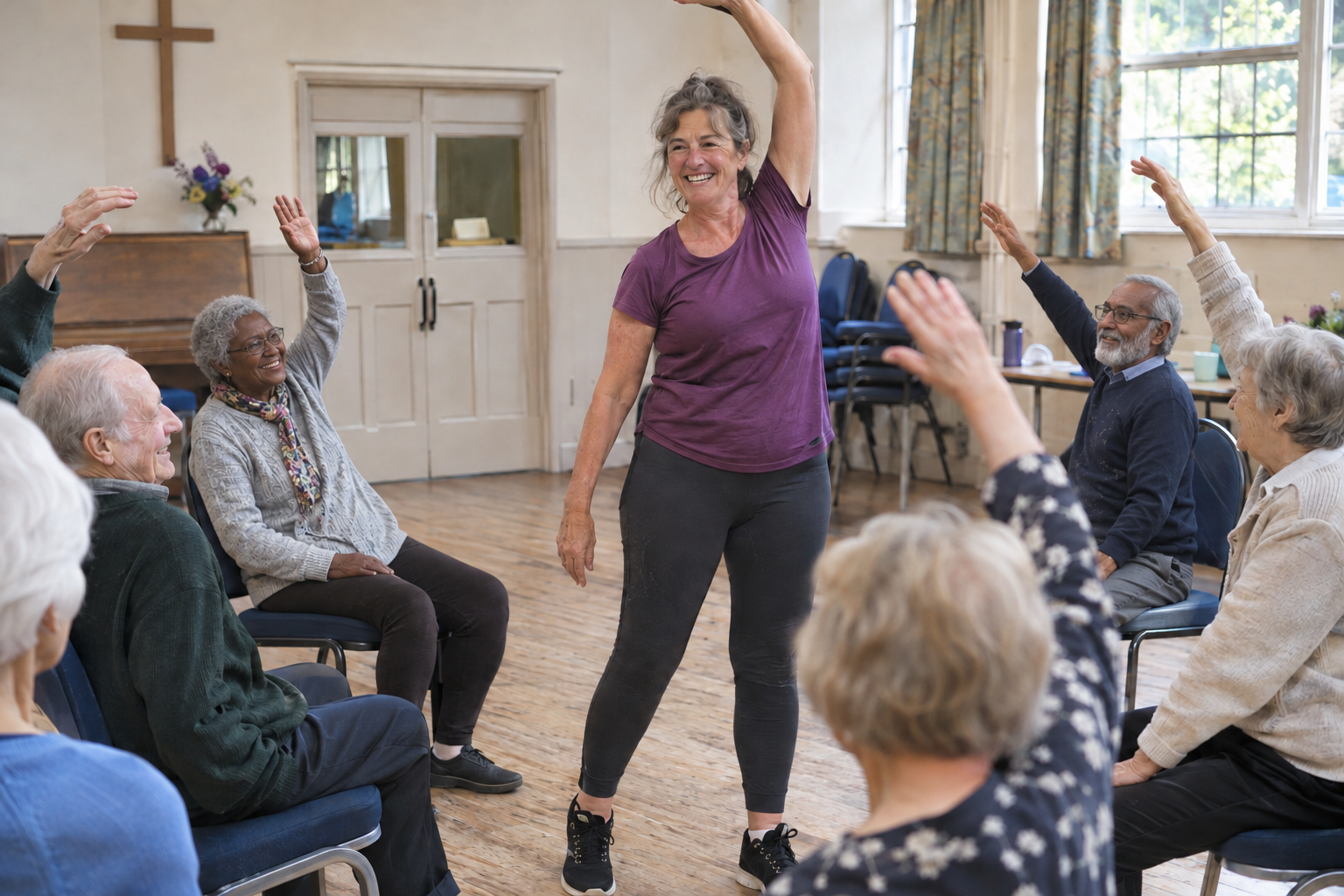
At Move it or Lose it we train people to run their own fun, music-led exercise classes for older adults, seated and standing, in community halls, care settings and gyms. It is a business where your age genuinely works in your favour:
- Your life experience is the job. More than half of the members in our 2026 Impact Report survey were aged 71 to 80. They want someone who understands them, not a 22-year-old personal trainer. Patience, warmth and people skills matter more than six-pack abs.
- Daytime hours. Most classes run on weekday mornings and early afternoons – no evenings, no weekends unless you want them. That makes it far easier to fit around caring or managing your own health.
- You choose how much you work. Run two classes a week for some extra income or build up to a full-time business. It is up to you.
- You keep 100% of what you earn. You set your own prices and we take no percentage of your class income.
- Low start-up costs. A one-off training fee, a hall, some music and a few chairs. No premises, no stock, no franchise fee.
- It keeps you active and connected too. Among instructors who answered the motivation questions in our 2026 Impact Report, 62% wanted to give back to their community and 62% wanted to stay active and have purpose.
- There is real demand. The UK population is ageing and we need more instructors to meet demand for classes across the country.
Many of our instructors trained in their fifties – for some it is a second career, for others a semi-retirement business. If you are wondering about age, read Am I too old to become a fitness instructor?
How it works
1. Train with the FABS Training Programme
FABS stands for Flexibility, Aerobic, Balance and Strength. You work through around 35 hours of guided eLearning at your own pace, then attend two practical training days (9am to 5:30pm on both days), online or face-to-face. There are no entry requirements and you don’t need a fitness background. The programme is CIMSPA endorsed and was developed with experts in ageing research.
Cost: £550 with online practical days or £600 face-to-face. Already a fitness professional? The Fast Track route is £375 online or £425 face-to-face.
2. Join our licensed network (optional)
For a flat £24 a month you can teach under the Move it or Lose it brand older adults already know and trust, get listed on our Classfinder so local people can find your classes, and get ongoing support and resources to help you fill your classes.
3. Start your classes
Find a local venue, set your timetable and price, and start small. Many people train alongside their current situation and build up classes week by week.
What could you earn?
Here is a deliberately conservative example. The average Move it or Lose it class costs around £7 a person. Fifteen people at £7 is £105 a class, so five classes a week over 48 weeks comes to about £25,200 a year before costs, and ten classes to about £50,400 before costs. Venue hire is your biggest cost, and the licence stays at £24 a month however many classes you run.
For the full breakdown, including venue hire, insurance and tax, see how much can you earn as an exercise instructor for older adults?
Request your free info pack
Tell us where you are and we’ll email you the course dates, the costs and what our instructors earn. No obligation.
"*" indicates required fields
We’ll email your free info pack within 5 minutes — if it hasn’t arrived, please check your junk folder. The email also includes a link to book a call with one of our team.
If you are caring for someone or managing a health condition
These are the two biggest reasons people in their 50s and 60s end up out of work, so it is worth being honest about how this fits. Because you choose your own hours and how many classes you run, you can build your timetable around care commitments or your own energy levels, and grow it gradually. Classes can be taught seated or standing. If you have a health condition, talk to us and to your GP about what would suit you before you book – we would much rather help you find the right route than have you start something that doesn’t fit.
More reading for a career change after 50
- How to change careers at 50: it’s not too late
- Career opportunities and work for over 60s
- A retirement career change: become a fitness instructor
- Become a Move it or Lose it instructor
Common questions
What does NETER stand for?
NETER stands for Not in Employment, Training, Education or Retirement. It is a new measure launched by the Centre for Ageing Better in September 2026 to count people aged between 50 and State Pension age who are not working but have not retired either – the older-age equivalent of NEETs.
How many NETERs are there in the UK?
According to the Centre for Ageing Better, there were 2.9 million NETERs in 2025 – just over one in five (21%) people aged 50 to State Pension age. Nearly 925,000 people in this age group were interested in work or actively looking for it at the end of 2025, the highest level since 2020.
Am I too old to become an exercise instructor at 50 or 60?
No. Many of our instructors trained in their fifties, and your life experience is a real advantage when you teach people in later life.
Do I need fitness experience or a gym qualification?
No. There are no entry requirements. The eLearning covers the science of ageing, safe exercise and how to motivate people before your two practical training days, and our trainers support you throughout.
Is Move it or Lose it a franchise?
No. There is no franchise fee, no territory to buy and we take no cut of your takings. You are self-employed and keep 100% of your class income. Joining our licensed network is optional and costs a flat £24 a month.
How much does the training cost?
The full FABS Training Programme costs £550 with online practical days or £600 face-to-face. If you are already a fitness professional, the Fast Track route costs £375 online or £425 face-to-face.
Sources
- Centre for Ageing Better, NETER: a new labour force measure (based on the ONS Labour Force Survey, Oct–Dec 2025).
- Centre for Ageing Better, Budget lacks any solutions to 50+ NETER employment crisis, 28 October 2026.
- The Telegraph, We can’t fix the youth jobs crisis at the expense of older workers, 2 November 2026.
- i, The experienced over-50s who can’t get even a job interview, 12 October 2026.
- Centre for Ageing Better, The NETER employment crisis, 7 September 2026.
Earnings figures are illustrative examples before costs, not a guarantee of income.